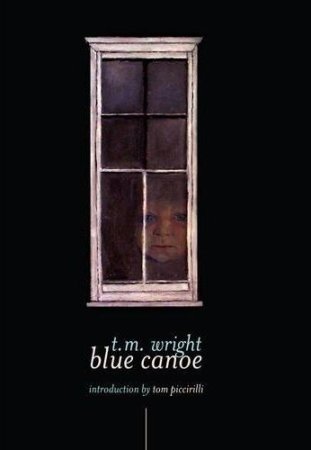
The December Special Guest Story is by T. M. Wright
Please feel free to visit T.M at: http://www.strangeseedmovie.com
THE BLUE-FACED MAN
by T. M. Wright
Dear Josephine,
In your recent letter, you wrote, “So tell me, what are your ideas about ghosts?” and I’ve been giving your question a good deal of thought, unexpected as it was, especially from someone such as you, so centered and so grounded in what passes for reality.
I’ll admit, though, that I can not answer your question directly: I’m sure you weren’t asking if I “believed” in ghosts. That’s simply not your style. Naked “belief” means little, whether we’re talking about ghosts or an “afterlife” or the possibilities for a successful existence. “Belief,” as I’m sure you realize, is a first cousin to “faith,” which, as you may also realize, isn’t something I embrace.
However, all of that being said…
Ghosts are spines, stomachs, spleens, nosebleeds, bad breath, lips puckered and reasons un-remarked. They’re doodles, too, slips of the tongue and insipient megalomania. They’re walks in the park, disinclination, remorse, knees out of whack, a long moment left behind (as all long moments must be).
Do you understand?
And they fly, they soar, they waddle, squat, dance, walk tip-toe; they’re as physical as words left unsaid, imaginings not gotten to, deaths unchallenged, challenged, and ignored.
They are the ignored.
They’re time in snippets, time in many snippets, time not characterized.
Do you know what I’m getting at, Josephine? Do you understand?
Ghosts are the whole that has become the not-whole, at last, and regret it.
They are repetition and repetitious; they long for headaches and heartaches, again, sores that heal quickly or badly or not at all, kisses that drip, hands that grip hard enough to hurt.
Ghosts are the poets of the great noisy silence, they are all the flotsam and jetsam of having been, nasty predilections and limitless brilliance trapped forever in the pitch dark.
Write back.
When you’re able, write back.
*****
Daniel,
Look at this city. Look at it. Squarely and with an artist’s focus. It’s as remarkable as we who live in it.
No, I don’t understand what you’ve written. “Ghosts are spines?” I don’t understand that. I don’t believe I want to understand it, and “…insipient megalomania?” I’m nowhere near understanding that, either.
But I have never really understood you, have I? You and your “nasty predilections”—whatever they might be. Perhaps someday you’ll tell me. Perhaps someday you’ll tell me.
And that is my reply this time.
Now I must feed my very hungry children, who are always in need.
*****
Josephine,
I do, at last, see this city with an artist’s focus. I’ve made love to it, wrestled with it, become cold as a winter’s sleep in it. It’s as forbidding, always, always, as a man with three hands, as remorseless as a badger; blood runs in its narrow streets and broad avenues, but it cannot be smelled or seen, except by the ignored.
I can only float through it, as do we all.
*****
Daniel,
I’ve never seen you float. I’ve seen you stumble, and I’ve seen you run, though simply to be on time, and I’ve seen you walk as steadily as any man can.
But float?
It is rarely that I’m not busy, but I feel I must respond to your letters although I’m certain my responses are disappointing, at best. You’re off on a journey again, and I understand the reasons for it. You’ve always been so restless, so restless. Even now.
Join us for a meal soon, will you? We’ll talk the way we used to. I’ll invite Anne and Harry, too. They’ve opened a shop not far from here; they sell wicker baskets of many shapes and sizes. It’s a good business and they claim to be doing well. Everyone’s got something to put in a wicker basket, don’t you think?
Surely you must have your easel set up somewhere in the city on these beautiful mornings.
*****
Josephine,
What a corrupt universe. We arrive in it, we arrive in it, I think, after having never left it. Does that mystify you? Is it fuzzy wordplay, no more than semantics?
It may be, but I would guess that it isn’t. I’d bet my internal organs on it, in fact, and, whatever the outcome, what would it matter? And who’s going to make the judgment in the first place; who’s going to decide the outcome?
Ghosts are epithets, spilled platters of cheese, a wedding gone sour.
Ghosts applaud without stopping—you can hear them on a quiet evening, if you listen very closely. Endless applause. It causes consternation among the wildlife.
You spend your nights in a small, dark-blue room, Josephine. I’ve seen it. And you sleep naked, naked, regardless of the temperature, which is endlessly enjoyable for passersby.
Yes, I have my easel set up in strategic areas these beautiful mornings. But do I paint what I see? No. What would be the use? My talent can not make better what my eye sees poorly or not at all.
Ghosts are bobbing heads and stiff recriminations and darkness suffused with the nothing-much: ghosts wake early, before sleep has overcome them. They’re time without movement, underwear at the knees, a brief buzz at the ear.
Ghosts long for the orgasm which will end, at last. And so they shriek and wail and complain and possess the gut, the night, the powder room, the small colorless area on the lawn.
I can not define you, Josephine. I can not define myself. I can only list the parts of the whole. And I can only guess at the whole, like a blind dog barking at movement in the bushes.
*****
Hello Daniel,
Your letters make me happy, small challenge to the brain that they are. Sometimes, even now, I see you at the end of a long street, easel under your arm, and I want to run to you. But I have children to feed. They are, it seems, never fed well enough.
They’re as demanding as disease.
Do you remember the painting you did of me, Daniel? Of course you do. I’d be heartbroken if you’d sold it. Did you? Did you sell it? And to whom?
There I go, asking questions for which I’ve received no answers and imposing my own answers on the equation. You’d say that was typical of me, and I’d agree, I’d agree.
A friend said, when I showed her your letters, “Ghosts are a melding of longing and need and memory.” What do you think of that? I find it profound.
Yes, I do still spend my evenings in the dark blue room and, yes, of course, I sleep naked regardless of the temperature. But there are no passersby; I would see them looking at me. Perhaps you are the only passerby, Daniel. Would you even know if that were true? Would I?
As long as we are discussing ghosts (in a haphazard way, like throwing darts at Mayflies), my guess is, my understanding is, that ghosts are confusion incarnate, or confusion re-incarnate. You say they’re “spleens” and “spines” and “reasons un-remarked,” et cetera, et cetera, but that’s only because confusion itself, which ghosts must surely be, amounts to the myriad parts of a thing, and when that thing, trying to remain whole, seeks to understand those myriad parts, seeks to bring them together into the whole, the sum of the parts, to become, once again, itself, all that can result is confusion, phrases out of context masking as definitions or lyricism. But it can be only futile guesswork, like trying to put together a puzzle that has become ashes.
Do you understand me, Daniel? Do you understand me?
*****
Well, Josephine,
And the dark-blue room in which you sleep so invitingly naked, Josephine, is only one of many rooms in a large gray stone house in a very large city made entirely of stone houses and shops that sell wicker baskets.
Ghosts sing at odd hours. And they sometimes sing well. Their harmonies are almost always perfect, though they don’t often sing in harmony, and when they do, it’s not as if it’s something they’ve planned, it’s simply coincidental—the harmonies of wind and rain, or the harmonies that passion produces.
I understand you completely. You have a gift, now, in these circumstances, for making yourself understood; you did not seem to possess that gift before.
And so there it is—“before.” Which ghosts are not. I was going to write that they are not “after,” as well. But I’ll save that idea, that discussion, that possibility, for another time.
Another time.
Another time.
Ghosts resemble children, adults, the old and the very old. They shake their heads occasionally, bend over occasionally, as if to look at something on the floor, on the sand, the sidewalk, the veranda; they peer around corners, sometimes as if surreptitiously, sometimes not.
And they are always, always...surprising.
*****
Dearest Daniel,
I remember your hands, Daniel. I remember all of you, of course, but I remember your hands, especially, because they are the most useful and the most graceful and supple hands I have ever experienced. They have their own intentions, I think—beyond the intentions of your brain and soul, intentions that are almost clear to me.
On some days, and some nights, I see your hands in places I don’t expect to see hands.
Ghosts, Daniel, are personal.
*****
Dear Josephine,
I’m the tall one who walks with a limp and I carry an easel around with me wherever I go, hoping for the right artistic moment, hoping now, of all times, for a better eye.
*****
Daniel,
“Snippets,” you wrote.
We become snippets, Daniel.
We become our children, our children become us. And then they make us whole.
Good news! I’m opening a shop of my own. I haven’t decided what to call it. I feel I should call it something. All shops have names, of course.
Anne and Harry were over not just long ago and they ate pie. I showed them your letters and they made some comment or two, and our conversation following was scant.
So many centipedes here, Daniel. So many. They’re like small exclamations of the night.
Remember that painting you did of me? Have you sold it?
*****
Dear Josephine,
I always open one eye when I’m nearing sleep: this has become a habit with me—not because I’m clinging to the reality of the room, the doors, the mirrors and the bedding, or my arm itself, which I sometimes use as a pillow. I open one eye when I’m nearing sleep, because—I can not now even guess how long ago—I was nearly at the point of sleep in a room here, in this place, and it was illuminated softly by early morning light, and I opened one eye, and, after a small moment, I saw another eye staring back at me. It was a dark and lucid eye in a face I could see little of—an eyebrow, a lift of forehead, a rounded cheek. I closed my eye; I felt the air move near my face. I opened my eye some minutes later, saw the room—a tall chest of drawers, a slight mirror, a window, the new morning beyond.
*****
Hello Daniel,
In the farmhouse where I grew up, Daniel, a man came in, when I was young enough not to realize his importance, and made a place for himself in the attic. I knew he was there but no one else did, not Father, nor Mother, my brother Jim, my sister, either. He lived in the attic for a week—during which I heard him moving about, dancing a little, eating food from plates, whispering at me through the floorboards—and then he left the farmhouse. No one ever, ever, went into the attic so no one but I knew he existed. Have I told you about him? He was a snippet. A snippet. I believe he came to see me now and again, when all the others in the house had gone to their jobs or their schools, leaving me by myself and barely young enough to know anything. I look at him in my memory, I see him in my memory. He’s the man in the attic who had sour breath and coarse gray whiskers. And he was as thin as straw, and he smiled at me, said, “Yes, there you are, Josephine,” and, “I’ve swallowed everything up there, little one,” and much else, through the floorboards, into my face, squarely, his mouth only inches from mine.
So many centipedes here, Daniel. Little night wigglers.
*****
Dear Josephine,
Ghosts are personal. Yes. Josephine. We don’t know their intentions, so they’re personal. They’re strangers, no matter what face we see staring back at us, so they’re personal.
I knew a woman who talked in clipped sentences and followed me from place to place for decades, decades, and her bright red hair was long and unclean and her lips and eyes dark. She talked in clipped sentences. “Hello, don’t!” for instance, and, “I’ll gather you inside me, yes,” and, “Maybe it’s today for that!”
I got locked in my room by my father when he was in his thirties. I was much younger than that, and he locked me in my room and boarded the windows. Stared at me. I remember his one eye.
You should invite me for a meal. We should enjoy a meal together soon, again.
Ghosts are Schwinn bikes, gingerbread cookies, long moments unexamined, tea stains.
Ghosts are despair, of course, Josephine. It’s in their hands and their skin, in their un-studied glances, their gait, that miserable two-step, their nonexistent bones (which got carried away, put in a hole) and their bare, trembling feet. They leave no stains but the stains of their despair wherever they are.
And they are...everywhere.
*****
Dear Daniel,
I’m not as relentlessly cheerless as you about the subject at hand, Daniel. Look, after all, at this city we live in, at our very existence. If you asked any of us here if we’d thought it possible, we would have had nothing to say but “No.”
But you’re right, yes, we’re followed wherever we go, even if we go nowhere we are observed constantly, and the eyes that observe us can not know us well enough. Have you discovered that?
I look back, I look back, and I see the unblinking eyes and the open mouths and I get a peek of pink tongue. I see hands in close detail, too—the river courses of the veins.
And the man in the attic had no name, I asked him, “Tell me your name,” and he said, “I have no name,” and I didn’t believe him because, of course, in that child’s brain, in the wildest of her imaginings, how could she believe that this man in the attic had no name, that he went about, from place to place (from attic to attic to attic) without a name? How does one leave traces of oneself without a name?
And there it is: he must have had a name or I wouldn’t remember him now, so very long later.
Also, there is the other child; she plagues this house as she plagued my father’s house.
She is “Erma,” which is sewn in black script into the yellow bodice of her blue dress. I see her around corners; I see her at my shoulder, as I did at my father’s house, and, there, at my father’s house, she whispered to me, as I passed beneath doorways, her secrets and nightmares, said, “Keep these.”
And I have.
She is here, now, Daniel. In this house. She steals the food my children much need, she clamps her hands on their ears as they sleep, and they wake screaming because they believe silence is death and that it has come for them.
She sprinkles centipedes on their pillows.
*****
Josephine,
Ghosts are the masks of congealed possibilities, they are the smashed heart and mid-morning’s cum cries, the octogenarian grasping at his memories, they are his memories coming apart, his memories squirming away while he sleeps, while he plays cards, while his grandchildren stare at him and wonder about themselves as he succumbs, slowly, before their eyes, and they grab for pieces of him, giggling and afraid.
You must invite me for a meal, my friend. I walk the streets of this place and I see much less than makes me comfortable, much more than makes me afraid.
Do you remember the drowning at the park in the suburbs? Do you remember the moving water and the blue-faced man?
I remember everything; I remember. I remember believing the long-dead mourning dove in the planter in the garden made us immune to bad things, but only as long as it lay undisturbed. And then Timmy disturbed it and the blue-faced man appeared in the park on his back, mouth open, and with naked feet, and then was taken away by people who laughed quietly.
Ghosts, Josephine. Ghosts go around picking up hair-thin bits of their gray matter. And then, Josephine, they see nothing useful in it because it is merely something that once was. But they pick it up anyway. They use it as food. And so they grow to be as thin as the legs of insects.
Ghosts, Josephine, beg loudly not to be heard.
*****
And, Daniel...
...there was this cat, when I was young, that followed me everywhere and bit me. It happened every day. Daniel, it happened every day. My arms and legs, my torso and then, at last, my face became crisscrossed with infection. I looked in mirrors. I recognized nothing that stared back.
And so she is here, too. In this stone house. She’s alive in all its small rooms; she sings at all hours, her cat cry, the cry of her; her harmonies with the stone walls.
And she follows my children, Daniel, who can not but try to turn and see her, so I see her for them.
The centipedes are everywhere.
Daniel, the centipedes are everywhere.
I’m opening a shop. Harry and Anne have opened a shop, too. They sell wicker baskets. Everyone has something to put in a wicker basket, don’t you think?
*****
Josephine,
I saw an ocean today. It was at a distance of many miles across the great gray expanse of the city and it encompassed the horizon like a cloak; it rose a little, fell, rose a little. As if it were breathing.
Who breathes, I wonder, for those who don’t?
Nothing exists, Josephine, quite as succinctly as a shoulder-width passage through the endless pitch dark.
I’ve dreamt of that. Have you? I wake to it, I briefly wake to it. And so I avoid sleep. I wake endlessly. I see, endlessly, an eye staring back.
Do you?
And what do you recall that’s certain?
Do you write with pencil, or do you write with pen? Josephine.
How is our communication accomplished except through the minds of others? Josephine.
Do you see the words slinking off, wriggling off, into the pitch dark?
Josephine.
Josephine.
Ghosts are storms completed.
They lie desperately in any bed not their own, eat unnoticed from empty bowls, keep what memories they haven’t yet lost in places they don’t recall.
Josephine, I know none of this.
I’m guessing at it. I’m guessing at the whole, only guessing at the whole.
I believe in the whole. It’s what I need.
I see you lying naked, no matter the temperature, in your dark blue room, and you’re either sleeping or waking, the difference between the two being, of course, absolutely, absolutely...nothing.
*****
Dear Daniel,
My window shows me a cloud of small and harmless insects.
Yet, I have no window.
My window shows me your easel, your hands, the river courses of the veins.
Erma.
She has done something with my children. Where are my children?
I have no window.
The nothing speaks ghastly well.
I have no window.
My dark blue room is so very cold. So very cold. So very cold. Daniel.
*****
Dear Josephine,
In your recent letter, you wrote, “So tell me, what are your ideas about ghosts?” and I’ve been giving your question a good deal of thought, unexpected as it was, especially from someone such as you, so centered and so grounded in what passes for reality.
T. M. Wright is the author of thirty novels including best-sellers such as Strange Seed, A Manhattan Ghost Story, and Cold House (which contains an introduction written by Jack Ketchum). A Manhattan Ghost Story has been published in fourteen languages, and both it and Cold House, as well as Strange Seed, have been on several “Best of the Genre” lists.
T. M. Wright has been described by Ramsey Campbell as a “one-man definition of the term ‘quiet horror.’” The former literary editor of Writer Online, one reviewer has called him “the best ghost story writer alive.” T.M. Wright’s first novel, The Intelligent Man’s Guide to Flying Saucers, was published in 1968 by A.S. Barnes, New Jersey. Cold House is part of his new collection, Bone Soup, published by Cemetery Dance with a Foreword by Tom Piccirilli. His novel Strange Seed is currently in the early stages of becoming a film.
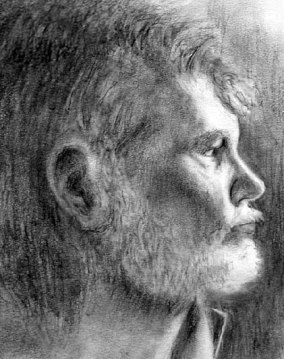
A father, grandfather, woodworker and artist, T. M. Wright loves Boston terriers, Maine coon cats, and vegetarian cuisine. He is also an accomplished artist, and drew his own self-portrait for The Horror Zine (above).